Showing posts with label Vietnam. Show all posts
Showing posts with label Vietnam. Show all posts
Friday, January 22, 2016
Hanoi mourns turtle Cu Rua - and Vietnams Communist Party is worried
The death of a turtle has shocked Vietnams Communist Party: The Yangtze giant softshell turtle Cu Rua was found dead in Hoan Kiem Lake in the centre of Hanoi. A legend says that the turtle - believed to be more than 100 years old - was the incarnation of a mythical creature living in the lake in the 15th Century. According to the legend Le Loi, who became emperor of Vietnam, borrowed a magical sword to fight against Vietnam's Chinese oppressors. After claiming independence, he came to the lake and returned the sword to a giant turtle in the lake. Thats how Hoan Kiem lake got its name: the Lake of the Returned Sword.
Some in the Communist Party, where a power struggle is ongoing and that started its Congress on Thursday, saw the death of Cu Rua as bad omen. Censors tried to prevent media to report the death, reported bbc.com. But the news of the death via Social Media could not be stopped.
The National Party Congress takes place every five years. Around the 12th Congress, opened on Thursday, there has been a lot of speculation about the outcome: the elections of the general secretary and the Prime Minister, the two top posts of the country. Anti-Chinese sentiments in Vietnam have grown in the past years after China’s actions in the South China Sea, where Vietnam and its larger northern neighbor both claim sovereignty over islands. The congress will end on January 28. General Secretary Nguyen Phu Trong is expected to keep his post according to aljazeera.com, "albeit for half the five-year term in an apparent compromise with his rival, Prime Minister Nguyen Tan Dung".
Tweet This


Friday, May 16, 2014
Vietnam has become very dangerous for Chinese People - the Reasons behind
At least 21 dead and nearly 100 injured in Vietnam after riots. Crowds set fire to industrial parks they believed to belong to Chinese people and hunted down workers. Read more on theguardian.com. Thursday morning a mob of thousand people stormed a giant Taiwanese steel mill in Ha Tinh province, central Vietnam.
This came two days after other mobs burned and looted foreign-owned factories in south Vietnam, believing they were Chinese-run, though many were actually Taiwanese or South Korean.
Chinese nationals have fled out of Vietnam. Cambodian Interior Ministry Spokesman Khieu Sopheak told the Anadolu Agency on Thursday that nearly 600 Chinese citizens had left Vietnam through the Bavet border crossing on Wednesday.
Anti-Chinese sentiment in Vietnam goes back to the time, when it was a Chinese colony - more than thousand years ago.
But there are more reasons for the Vietnamese people to be angry at Chinese people, as chinhdangvu.blogspot.com points out. Vietnamese are livid about China's attempt to drill for oil in waters claimed by Vietnam. But this is not the only reason. "Over the past few years there have been dozens of strikes at foreign-owned plants in Vietnam. Complaints about low pay, bad workplace conditions (poor canteen food, limits on using the toilet and so on) and bullying management have triggered disputes", writes Bill Hayton on bbc.com. These complaints have focused on plants owned by Taiwanese, Korean, Thai and Singaporean. And some factories, particularly Taiwanese-owned plants, "have been employing Chinese workers in favour of local Vietnamese".
The riots have consequences: Foxconn, the Taiwanese company that manufacturers iPhones and iPads for Apple, has shut operations in Vietnam for three days according to Financial Times. Meanwhile Samsung, which is a large investor in Vietnam, and Canon, the Japanese camera maker, said they had no plans to halt operations in the country. But Vietnam's Council of Taiwanese Chambers of Commerce has issued a warning to Chinese businesses that may be targeted in the next few days. It urged these firms to raise the Vietnamese flag over their offices and to remove or cover Chinese characters on their buildings or gates, reports South China Morning Post.
Police has detained about 1,300 people in anti-Chinese protests that have recently swept across southern and central Vietnam, a source in Vietnamese police told ITAR-TASS on Friday.
Vietnamese Prime Minister Nguyen Tan Dung sent a text message to Vietnamese cellular subscribers yesterday. He wrote Patriotic Vietnamese shouldn’t allow “bad elements” to “harm the interests and images of the country”.
Vietnam has a lot to loose if its anti-Chinese riots continue, writes Quartz. Vietnam relies heavily on foreign investment and tourism. Industrial output from foreign-owned industries has been rising, and made up 46% of the country’s overall industrial output in 2012.
Tweet This
This came two days after other mobs burned and looted foreign-owned factories in south Vietnam, believing they were Chinese-run, though many were actually Taiwanese or South Korean.
Chinese nationals have fled out of Vietnam. Cambodian Interior Ministry Spokesman Khieu Sopheak told the Anadolu Agency on Thursday that nearly 600 Chinese citizens had left Vietnam through the Bavet border crossing on Wednesday.
Anti-Chinese sentiment in Vietnam goes back to the time, when it was a Chinese colony - more than thousand years ago.
But there are more reasons for the Vietnamese people to be angry at Chinese people, as chinhdangvu.blogspot.com points out. Vietnamese are livid about China's attempt to drill for oil in waters claimed by Vietnam. But this is not the only reason. "Over the past few years there have been dozens of strikes at foreign-owned plants in Vietnam. Complaints about low pay, bad workplace conditions (poor canteen food, limits on using the toilet and so on) and bullying management have triggered disputes", writes Bill Hayton on bbc.com. These complaints have focused on plants owned by Taiwanese, Korean, Thai and Singaporean. And some factories, particularly Taiwanese-owned plants, "have been employing Chinese workers in favour of local Vietnamese".
The riots have consequences: Foxconn, the Taiwanese company that manufacturers iPhones and iPads for Apple, has shut operations in Vietnam for three days according to Financial Times. Meanwhile Samsung, which is a large investor in Vietnam, and Canon, the Japanese camera maker, said they had no plans to halt operations in the country. But Vietnam's Council of Taiwanese Chambers of Commerce has issued a warning to Chinese businesses that may be targeted in the next few days. It urged these firms to raise the Vietnamese flag over their offices and to remove or cover Chinese characters on their buildings or gates, reports South China Morning Post.
Police has detained about 1,300 people in anti-Chinese protests that have recently swept across southern and central Vietnam, a source in Vietnamese police told ITAR-TASS on Friday.
Vietnamese Prime Minister Nguyen Tan Dung sent a text message to Vietnamese cellular subscribers yesterday. He wrote Patriotic Vietnamese shouldn’t allow “bad elements” to “harm the interests and images of the country”.
Vietnam has a lot to loose if its anti-Chinese riots continue, writes Quartz. Vietnam relies heavily on foreign investment and tourism. Industrial output from foreign-owned industries has been rising, and made up 46% of the country’s overall industrial output in 2012.
Tweet This
Tuesday, April 2, 2013
Where have all the colours of Halong Bay gone?
 Picture by Fathzer
White is now the colour of all the boats on Halong Bay. The traditional brown colour of the wooden junks has gone.
Where has the old beauty and charm of Halong Bay suddenly gone? "When we look out over the bay, we saw hundreds of cruise boats, all of them painted white and in desperate need of a fresh coat of paint", write neilandjackie. "Flanked by high-end condominium developments, the port today looked so sanitized, so developed, a bit Disney-esque, in fact. Exotic no more", complain Traveling Soulmates. "All the boats where white, wooden and in noticeable disrepair. I’m starting to guess that paint is more expensive than gold in Vietnam, since no one seems to have used any in the last 30 year", comments Here Comes The Planet. Where have the old times gone, when exotic traditional junk boats in brown, read and black were sailing the bay?
It was on January 5 in 2012, when the provincial People’s Committee of Quang Ninh issued a suprising decision: All tourist boats on Halong Bay, except dragon boats, should be white with brown sails. Boats which fail to follow the decision by April 30 would have their licenses revoked. Boats with dragon heads are permitted to paint the dragon heads by traditional colour. "The move aimed to tighten government control over tourist transport, especially the boats providing over-night accommodations in Ha Long Bay", wrote Thanh Nien News. More than 500 boats were affected by this decision. A letter sent to the authorities by the Association for Ha Long Tourist Boats expressing disagreement had no effect. Pham Van Hoa, director of Bai Tho Transport Co., said the change was unnecessary, because tourists tend to like the traditional brown of Ha Long Bay’s wooden boats. He was not heard. Doan Van Dung, chief of the tourist boat association, said by painting all boats white, Ha Long Bay would lose an endearing characteristic – the traditional brown of Asian culture. He was not heard. “Foreign tourists have been always impressed with the brown and black colours of the boats on the bay, which are imbued with Vietnamese cultural identity,” said the deputy director of the Vietsky Travel Company, Dao Hong Thuong. “That’s why we shouldn’t copy foreign cruise ships and require the boats to be white.” He was not heard.
It is not clear, what really lead to the decision of painting all the boats in white. Some rumours say, the officials wanted to copy the white of the yachts seen in the ports of Sydney in Australia or Greece in Europe. Some say, the idea was to attract more tourists to Halong Bay. Bu this seems to be backfiring more and more: "What we found really upsetting was the rubbish floating around everywhere. No way I would go swimming there! Having lived in New Zealand for five years where nature is very well looked after coming here was a real disappointment. From what we were told the majority of boats do not have sewage tanks so everything goes straight into the water", observes flauschipoohbear on tripadvisor.com. "It smelled horrible from the pollution in the bay. Such a shame. we saw raw sewage being dumped and it was common to see toilet paper that had not broken down yet, trash and oil floating on the surface", adds travelswithmimi.
In Halong Bay you can see today, that Vietnam is in danger of committing tourism hara-kiri. On March 24 in 2013 Thanh Nien News has published an alarming report about distructure of nature and natural landscapes also by tourism. Ha The Tien, an engineer working on a ship in Ha Long says most vessels discharge waste, including from toilets, directly into the water. “Each passenger boats discharge an average of 2,000-3,000 liters of waste every day. With 500 tourism boats, it’s up to 1.5 million liters of untreated waste discharged into the bay." Such a report by a newspaper which is owned by the Vietnam National Youth Federation and has become one of the most influential newspapers in Vietnam, shows, that the Vietnamese authorities start to recognise the problems created by uncontrolled tourism development. May be the white colour of all the boats on Halong Bay does not stand just for whitewashing.
Read earlier stories:
How to choose the right junk for Halong Bay
How the dream turned into a nightmare on Halong Bay
Tweet This
Sunday, December 16, 2012
Bac Ha Market: The colours of life
See the locations on Bac Ha Google Map
 Picture by Canadian Veggie
Every Sunday the market of Bắc Hà is an overwhelming mixture of colours and tastes. Embroidered clothes and bags of the Flower Hmong and the visible joy around trying and bartering between sellers and buyers are in the centre of all, but buffalos, horses, dogs, cats and chicken are traded here as well as local vegetables, corns and fruits. The market attracts villagers from the surrounding hill tribes: H’mong, Red Dao and Ha Nhi people. Some walk several hours from their villages, others arrive by motorbikes.
 Picture by marhas
Embroidered clothes of the Flower Hmong
 Picture my marhas
 Picture by marhas
The much sought-after bags of the Flower Hmong
 Picture by marhas
 Picture by marhas
The chicken are going to change the owner
 Picture by marhas
The horse market
 Picture by marhas
A bird and the money change hands
 Picture by marhas
At the buffalo market
 Picture by marhas
 Picture by marhas
 Picture by marhas
Puppets and silver jewelry
 Picture by marhas
The animals of Bac Ha
 Picture by marhas
Shimmering cups
 Picture by marhas
What grows nearby
 Picture by marhas
Bananas not from far away
No market is complete without the food corner:
 Picture by marhas
Meat soup (horse or buffalo) sizzling on a coal fire. The horse soup is called “Thang co”.
 Picture by marhas
Fried delicacies
Picture by marhas
Fried delicacies
 Picture by marhas
Buy some corn
 Picture by marhas
End of life for the pig

Eating and seeing the cook cooking - the show kitchen
See more pictures of Bac Ha Market by marhas
 Picture by Joel Abroad
Bac Ha (700 m above sea level) reveals its most stunning beauty in the spring when peach and Tam Hoa plum trees are in full blossom. You discover the most beautiful plum gardens in Ban Pho Village at the foot of Co Tien Mountain, around 4km from Bac Ha Town. Therefore Bac Ha is also called "Cao nguyen trang" (White Valley). And the plum wine is excellent. 14 ethnic minority groups inhabit the area, among them Flower Hmong, Dzao, Giay (Nhang), Han (Hoa), Xa Fang, Lachi, Nung, Phula, Thai and Thulao and the Kinh (ethnic Vietnamese. Bac Ha Temple is dedicated to Gia Quoc Cong Vu Van Mat. On the seventh day of the seventh lunar month a festival is held at Bac Ha Temple.
Hoang A Tuong Castle - the palace of the Hmong King
 Picture by Joel Abroad
Hmong Kings Palace at Ban Pho near Bac Ha
Hoang A Tuong Castle is located 300 m from Bac Ha Market. It is a combination of Western architecture and Oriental Feng Shui principles. The owner of this two- storey building was Hoang Yen Chao (of Tay origin). He was a local mandarin. The castle was built between 1914 and 1921 on a low hill overlooking the Bac Ha Valley.
Villages around Bac Ha provide a good opportunity to see how the people live. Ban Pho is the nearest. The Flower Hmong villagers are extremely hospitable and very kind. Ban Pho is a 1.7 km return trip from Bac Ha. Other nearby villages are Trieu Cai, an 8 km return walk; Na Ag, a 6 km return walk; and Na Hoi, a 4 km return walk.
 Picture by marhas
Outlook from Ban Pho
Where you stay in Bac Ha
Anh Duong Guesthouse: Phone (+84-203) 880329. "Is a friendly place that overlooks the market. Rooms are small, but are bright and were renovated in 2002", writes vanhaitourism.com.
Cong Fu Hotel: 152 Ngoc Uyen street. Mixed reviews on tripadvisor.com
Dai Thanh Hotel: Phone (+84-203) 880488.
Dang Khoa Hotel: Phone (+84-203) 880290.
Minh Quan Hotel: Phone (+84-203) 880222. "A good hotel, with comfortable rooms, and balconies with views over the Bac Ha market and mountains", writes vanhaitourism.com.
Ngan Nga Hotel: Quite good reviews on tripadvisor.com.
Sao Mai Hotel: Phone (+84-203) 880288. Rooms in old concrete building and two newer wooden houses. Mixed reviews on tripadvisor.com.
Sunday Hotel: From 25 USD. 001 Vũ Văn Mật.
Tran Sin Hotel: Phone (+84-203) 880240. Overlooking the market, has balconies and mountain views from some rooms.
Tuan Anh Guesthouse: Phone (+84-203) 880377.
Tuan Lien: Phone (+84-203) 880261. Just next door to the Tran Sin.
Bac Ha Homestay: This homestay is located in Na Lo village, Ta Chai commune. The owner is Mr Vang A Van, he belong to the Tay people. Here they have hot water for shower. If you want you can have dinner & breakfast with their family.
How you arrive in Bac Ha
Minibuses depart from Lao Cai (40,000 Dong, two hours) around 6.30 am, 11 am and 1 pm daily. Buses from Bac Ha leave around 5.30 am, 11.30 am and 1 pm.
Learn about Sapa: Sapa Impressions
Where to stay in Sapa: Hotels and Guesthouses in Sapa and reviews of guests
Restaurants in Sapa: Where you eat in Sapa
Tweet This
 Picture by Canadian Veggie
Every Sunday the market of Bắc Hà is an overwhelming mixture of colours and tastes. Embroidered clothes and bags of the Flower Hmong and the visible joy around trying and bartering between sellers and buyers are in the centre of all, but buffalos, horses, dogs, cats and chicken are traded here as well as local vegetables, corns and fruits. The market attracts villagers from the surrounding hill tribes: H’mong, Red Dao and Ha Nhi people. Some walk several hours from their villages, others arrive by motorbikes.
 Picture by marhas
Embroidered clothes of the Flower Hmong
 Picture my marhas
 Picture by marhas
The much sought-after bags of the Flower Hmong
 Picture by marhas
 Picture by marhas
The chicken are going to change the owner
 Picture by marhas
The horse market
 Picture by marhas
A bird and the money change hands
 Picture by marhas
At the buffalo market
 Picture by marhas
 Picture by marhas
 Picture by marhas
Puppets and silver jewelry
 Picture by marhas
The animals of Bac Ha
 Picture by marhas
Shimmering cups
 Picture by marhas
What grows nearby
 Picture by marhas
Bananas not from far away
No market is complete without the food corner:
 Picture by marhas
Meat soup (horse or buffalo) sizzling on a coal fire. The horse soup is called “Thang co”.
 Picture by marhas
Fried delicacies
Picture by marhas
Fried delicacies Picture by marhas
Buy some corn
 Picture by marhas
End of life for the pig

Eating and seeing the cook cooking - the show kitchen
See more pictures of Bac Ha Market by marhas
 Picture by Joel Abroad
Bac Ha (700 m above sea level) reveals its most stunning beauty in the spring when peach and Tam Hoa plum trees are in full blossom. You discover the most beautiful plum gardens in Ban Pho Village at the foot of Co Tien Mountain, around 4km from Bac Ha Town. Therefore Bac Ha is also called "Cao nguyen trang" (White Valley). And the plum wine is excellent. 14 ethnic minority groups inhabit the area, among them Flower Hmong, Dzao, Giay (Nhang), Han (Hoa), Xa Fang, Lachi, Nung, Phula, Thai and Thulao and the Kinh (ethnic Vietnamese. Bac Ha Temple is dedicated to Gia Quoc Cong Vu Van Mat. On the seventh day of the seventh lunar month a festival is held at Bac Ha Temple.
Hoang A Tuong Castle - the palace of the Hmong King
 Picture by Joel Abroad
Hmong Kings Palace at Ban Pho near Bac Ha
Hoang A Tuong Castle is located 300 m from Bac Ha Market. It is a combination of Western architecture and Oriental Feng Shui principles. The owner of this two- storey building was Hoang Yen Chao (of Tay origin). He was a local mandarin. The castle was built between 1914 and 1921 on a low hill overlooking the Bac Ha Valley.
Villages around Bac Ha provide a good opportunity to see how the people live. Ban Pho is the nearest. The Flower Hmong villagers are extremely hospitable and very kind. Ban Pho is a 1.7 km return trip from Bac Ha. Other nearby villages are Trieu Cai, an 8 km return walk; Na Ag, a 6 km return walk; and Na Hoi, a 4 km return walk.
 Picture by marhas
Outlook from Ban Pho
Where you stay in Bac Ha
Anh Duong Guesthouse: Phone (+84-203) 880329. "Is a friendly place that overlooks the market. Rooms are small, but are bright and were renovated in 2002", writes vanhaitourism.com.
Cong Fu Hotel: 152 Ngoc Uyen street. Mixed reviews on tripadvisor.com
Dai Thanh Hotel: Phone (+84-203) 880488.
Dang Khoa Hotel: Phone (+84-203) 880290.
Minh Quan Hotel: Phone (+84-203) 880222. "A good hotel, with comfortable rooms, and balconies with views over the Bac Ha market and mountains", writes vanhaitourism.com.
Ngan Nga Hotel: Quite good reviews on tripadvisor.com.
Sao Mai Hotel: Phone (+84-203) 880288. Rooms in old concrete building and two newer wooden houses. Mixed reviews on tripadvisor.com.
Sunday Hotel: From 25 USD. 001 Vũ Văn Mật.
Tran Sin Hotel: Phone (+84-203) 880240. Overlooking the market, has balconies and mountain views from some rooms.
Tuan Anh Guesthouse: Phone (+84-203) 880377.
Tuan Lien: Phone (+84-203) 880261. Just next door to the Tran Sin.
Bac Ha Homestay: This homestay is located in Na Lo village, Ta Chai commune. The owner is Mr Vang A Van, he belong to the Tay people. Here they have hot water for shower. If you want you can have dinner & breakfast with their family.
How you arrive in Bac Ha
Minibuses depart from Lao Cai (40,000 Dong, two hours) around 6.30 am, 11 am and 1 pm daily. Buses from Bac Ha leave around 5.30 am, 11.30 am and 1 pm.
Learn about Sapa: Sapa Impressions
Where to stay in Sapa: Hotels and Guesthouses in Sapa and reviews of guests
Restaurants in Sapa: Where you eat in Sapa
Tweet This
Tuesday, November 20, 2012
Where you eat in Sapa:
Restaurants and your reviews
See the locations on Sapa Restaurants Google Map by #treasuresofvietnam
Follow the locals has always been the way of this blogwriter. So you should try the food stalls along Pham Xuan Huan. Here you get pho and rice, barbecued meat and rice wine.
 Picture by felixtriller
Restaurants in Sapa:
Baguette & Chocolat: Thac Bac. Part of the Hoa Sua School, that trains disadvantaged children in hospitality. Excellent sweets, good breakfasts, salads, pastas and Vietnamese dishes. Also the teas (ginger, lemongrass) get good reviews on tripadvisor.com.
 Picture by sega128
Delta Restaurant: 33 Cau May Street. "Renowned for its pizzas, which are the most authentic in town, though the pasta is pretty decent too", notes lonelyplanet.com. Good reviews on tripadvisor.com.
Gerbera Restaurant: 04B Thac bac Street. Delicious vietnamese meals, for example hotpots, according to tripadvisor.com.
 Picture by n robynejay
Red Dao House Restaurant: Thac Bac Street. In a traditional wooden house on stilts. Vietnamese and Western cuisine. Very good reviews on tripadvisor.com.
 Picture by marhas
Red Dao House
 Picture by marhas
Pumpkin soup
 Picture by marhas
Funny menu card, but not a culinary desert
Sapa Coffee Corner: 20 Pham Xuan Huan. Long tables with chairs create a community spirit.
Sapa O'Chau Cafe: 8 Thac Bac Street. Information centre about Sapa O'Chau Project. With the help of four Australian tourists, Shu Tan, a young, single mother from the Black Hmong tribe, was able to open the first Hmong owned homestay in Sapa and supported Shu to establish a socially conscious trekking sevice. Sapa O’Chau put the money earned back into the community through projects such as providing winter clothes to children and improvements to the village schools. Later Shu organized informal English night classes for young tour guides. Today Sapa O’Chau has over 70 students (35 of which live at the Centre) and runs classes in English and Vietnamese literacy, vocational training, traditional song & dance and arts and crafts. In addition Sapa O'Chau provides support for students and their families so that they do not have to return to street-selling for income. Read more.
Sapa Rooms: Vegetarian, Vietnamese, Organic cuisine and Winery. Very good reviews on tripadvisor.com, be it for roast pumpkin soup, banana flower salad with grilled chicken, pork in fresh coconut in a claypot served with steamed rice or juices with names like summer morning, spring boost and sapa special.
The French Bakery: 46 Cau May Street. Excellent patisseries.
The Hill Station: 07 Muong Hoa Street. This restaurant gets good notes for wine, ham, cheese and sandwiches on tripadvisor.com.
Viet Emotion: 27 Cau May. Pancakes, Pizza, Tapas, Asian Food, books and magazines. Good reviews on tripadvisor.com.
More restaurants in Sapa:
vietnamonline.com
lonelyplanet.com
travelfish.org
www.sapalaocai.com
frommers.com
Learn first about Sapa: Sapa Impressions
Where to stay in Sapa: Hotels and Guesthouses in Sapa and reviews of guests
Where to go from Sapa: Discoveries around Sapa
Tweet This
Follow the locals has always been the way of this blogwriter. So you should try the food stalls along Pham Xuan Huan. Here you get pho and rice, barbecued meat and rice wine.
 Picture by felixtriller
Restaurants in Sapa:
Baguette & Chocolat: Thac Bac. Part of the Hoa Sua School, that trains disadvantaged children in hospitality. Excellent sweets, good breakfasts, salads, pastas and Vietnamese dishes. Also the teas (ginger, lemongrass) get good reviews on tripadvisor.com.
 Picture by sega128
Delta Restaurant: 33 Cau May Street. "Renowned for its pizzas, which are the most authentic in town, though the pasta is pretty decent too", notes lonelyplanet.com. Good reviews on tripadvisor.com.
Gerbera Restaurant: 04B Thac bac Street. Delicious vietnamese meals, for example hotpots, according to tripadvisor.com.
 Picture by n robynejay
Red Dao House Restaurant: Thac Bac Street. In a traditional wooden house on stilts. Vietnamese and Western cuisine. Very good reviews on tripadvisor.com.
 Picture by marhas
Red Dao House
 Picture by marhas
Pumpkin soup
 Picture by marhas
Funny menu card, but not a culinary desert
Sapa Coffee Corner: 20 Pham Xuan Huan. Long tables with chairs create a community spirit.
Sapa O'Chau Cafe: 8 Thac Bac Street. Information centre about Sapa O'Chau Project. With the help of four Australian tourists, Shu Tan, a young, single mother from the Black Hmong tribe, was able to open the first Hmong owned homestay in Sapa and supported Shu to establish a socially conscious trekking sevice. Sapa O’Chau put the money earned back into the community through projects such as providing winter clothes to children and improvements to the village schools. Later Shu organized informal English night classes for young tour guides. Today Sapa O’Chau has over 70 students (35 of which live at the Centre) and runs classes in English and Vietnamese literacy, vocational training, traditional song & dance and arts and crafts. In addition Sapa O'Chau provides support for students and their families so that they do not have to return to street-selling for income. Read more.
Sapa Rooms: Vegetarian, Vietnamese, Organic cuisine and Winery. Very good reviews on tripadvisor.com, be it for roast pumpkin soup, banana flower salad with grilled chicken, pork in fresh coconut in a claypot served with steamed rice or juices with names like summer morning, spring boost and sapa special.
The French Bakery: 46 Cau May Street. Excellent patisseries.
The Hill Station: 07 Muong Hoa Street. This restaurant gets good notes for wine, ham, cheese and sandwiches on tripadvisor.com.
Viet Emotion: 27 Cau May. Pancakes, Pizza, Tapas, Asian Food, books and magazines. Good reviews on tripadvisor.com.
More restaurants in Sapa:
vietnamonline.com
lonelyplanet.com
travelfish.org
www.sapalaocai.com
frommers.com
Learn first about Sapa: Sapa Impressions
Where to stay in Sapa: Hotels and Guesthouses in Sapa and reviews of guests
Where to go from Sapa: Discoveries around Sapa
Tweet This
Saturday, August 11, 2012
Sapa - a magic mountain scenery above the mist
See the locations on Sapa Google Map and see the Weather in Sapa
 Picture by marhas
Sapa morning: The mist is leaving and the view towards the valley with the rice terraces is opening
 Picture by Lawrence Sinclair
 Picture by ronancrowley
 Picture by n gr0uch0
Sapa Square with churchbr>
It's a long one-hour drive from the town Lao Cai on a road winding up into the Hoan Lien Son mountain range near the Chinese border in northwestern Vietnam. Up to 1650 m above sea level. Into a town, that may be still enclosed by mist, when you arrive early in the morning. There you may witness, how the mist is floating away and discloses a fine rugged scenery and rich cultural diversity, great views into the surrounding mountains and valleys, towards the famous rice terraces with the farm houses of the hill tribe people (Hmong and Dao) living around this town in the Tonkinese alps. The picturesque village is a former French hill station near Fansipan, the highest peak in Vietnam, rising from the Red River Valley. And you find here a very special atmosphere: something between a Vietnamese hilltribe-market-town and a skistation in the French mountains. Sapa’s streets are the business place to the Hmong, Dao, Giay, Pho Lu and Tay people. Their traditional ethnic dresses make the difference from the many nations, who come to Sapa to plunge in its landscape. The women of these groups carry their handmade goods on their backs in traditional wicker baskets to barter and trade with tourists.
 Picture by marhas
Cau May street: Full of restaurants, handicraft- and outdoorshops and leading to the market

Muong Hoa Street: Wine and chocolate and more food
 Picture by marhas
Cau May Street: The Hilltribe Mini Hotel, the Highland Bakery Restaurant and the Sapa Trekking Shop
 Pictures by marhas
Pastries in the window of Highland Bakery
 Picture by marhas
Crafts and fashion
 Picture by marhas
Skipants in Sapa? Sometimes Sapa sees some snow - and normally a lot of tourists buying outdoorclothes
 Picture by marhas
Flowers at the market
 Picture by Hector Garcia
Black Hmong women at Sapa market
 Picture by marhas
Black Hmong women waiting
 Picture by marhas
Sapa street food
 Picture by Arian Zwegers
 Picture by marhas
In the evening: The mist creeps around the corner
Red Dzao Traditional Medicine Bath: 10 Thac Bac Street. Read about this experience. Due to the isolation in the mountains herb medicine plays an important role in protecting the health of the Dao people. There are plenty of herbs in the forests. During the herbal bath they drink restoratives. This helps women recuperate after giving birth, stimulate their appetite and protect infants from disease via their mothers milk. According to the wisdom of the Dao people a herbal bath helps against physical and mental fatigue and it enhances blood circulation. For women the herbal bath promises skin beauty by opening pores, removing dead skin and impurities. Read more: Trying medicinal bathing with the Dao
 Picture by marhas
Red Dzao Traditional Medicine Bath
There is something in Sapa, that can be enervating. "Welcome to Sapa, home of the hard sell", writes the Ottawa Citizen. Susan Riley describes: "From the moment you step out of your minivan in the town of Sapa (...) you will be besieged by Hmong women - short, friendly, decked out in bright head scarves, patterned umbrellas and dark leggings and as persistent as black flies. They followed us everywhere (...) - even on a three-hour "trek" through high pastures, sodden rice paddies and down slippery goat paths to a neighbouring village. We told them we weren't buying the blankets, trinkets and scarves they carry in woven baskets; we asked them politely to let us walk in peace; finally, we affected tight smiles and tried ignoring them." As tourist you are really in the dilemma: You would like to be polite and answer their questions (where are you from?), but if you do this, you encourage them to follow you because they think sooner or later you are going to buy from them. "Don't talk to them", is the advise of the local Tay guide, who shows the author of this blog around. Another advise: "Say you are Belgian - they know that Belgians newer buy". Or should you buy, because you are a rich tourist and should give something of your richness away, because you know, that many people in the mountains of Vietnam are still poor and have not a lot of possibilities in their lifes? You are in a dilemma.
The tourism boom in Sapa has its backside. Some parents take the children out of school and send them to sell things to tourists. But there is an organization fighting against this and better education and formation for children: Sapa O'Chau. This organization, founded by Shu, a Black Hmong woman (see video1 and video2), is attracting children to their school classes of English language and guidework and then send the well prepared young guides to tours with guests or other work in the tourism. Today Sapa O'Chau has over 70 students. And you can get here experienced guides for trekking tours or tours to local markets.

Sapa O'Chau Café - where you book tours with their guides
While Sapa itself has much adapted to tourism - with more and more guesthouses and hotels lining its streets, all competing for the best views, with restaurants for many tastes of the world - the landscape around the town remains stubbornly untouched: Rice terraces, who have been built by generations, water buffaloes, pigs and ducks in between and the hilltribe people working in the rice paddies and on their handicrafts.
Special nights in Sapa used to be Saturday evenings. Then men and women from the surrounding hilltribes come to the "Love market" or better: dating market (Cho Tinh, see pictures). Which is described by edbourke.net. But the growing interests of tourists has destroyed this event. Young people now find other ways to date. What happens now is described by vietnamnet.vn.
Sapa Museum:
 Picture by marhas
Hmong Shaman Altar
The main season for vistors is from September to November or from March to May with dry sunny days and cool nights.
 Picture by jmhullot
 Picture by Palojono
Sunset at Tram Ton Pass, after driving up from Sapa
 Picture by alex franka
Hmong village
A two to three hours drive from Sapa lies Bac Ha, a Hmong village. It has a Sunday market. You can get tours to this market, taking you at Lao Cai railway station when you arrive in the morning and afterwards bring you to your hotel in Sapa or the other way round, when you leave Sapa on Sunday, for example here.
 Picture by Tartarin2009
Bac Ha market
How you get to Sapa
By train:
From Hanoi to Lao Cai at the Chinese border (7 to 8 hours). You can travel with sleepers and book on vietnamrailways.com. Then get to the right railway station in Hanoi: The entrance is from Tran Quy Cap Street. See Hanoi Railway Station Google Map. From Lao Cai buses to Sapa (1 1/4 hour), take seat on the left side to have the best view.
Overland Travel to Luang Prabang: There’s no direct bus going to Luang Prabang from Sapa, notes flipnomand.com. His minivan left at around 8 am and took around eight hours to reach Dien Bien Phu (12 USD). There he took the bus to Mhuang Khua in Laos (5 USD) at 5.30 am via Tay Trang Border and arrived at around 2.30 pm. There he took a minibus the next morning to Udomxay and there another bus to Luang Prabang.
Where to stay in Sapa: Sapa Hotels and Guesthouses
Where to go from Sapa: Discoveries around Sapa
Restaurants: Where you eat in Sapa
 Picture by johnlemon
Rice fields down in Sapa Lao Cai
 Picture by ronancrowley
Tweet This
 Picture by marhas
Sapa morning: The mist is leaving and the view towards the valley with the rice terraces is opening
 Picture by Lawrence Sinclair
 Picture by ronancrowley
 Picture by n gr0uch0
Sapa Square with churchbr>
It's a long one-hour drive from the town Lao Cai on a road winding up into the Hoan Lien Son mountain range near the Chinese border in northwestern Vietnam. Up to 1650 m above sea level. Into a town, that may be still enclosed by mist, when you arrive early in the morning. There you may witness, how the mist is floating away and discloses a fine rugged scenery and rich cultural diversity, great views into the surrounding mountains and valleys, towards the famous rice terraces with the farm houses of the hill tribe people (Hmong and Dao) living around this town in the Tonkinese alps. The picturesque village is a former French hill station near Fansipan, the highest peak in Vietnam, rising from the Red River Valley. And you find here a very special atmosphere: something between a Vietnamese hilltribe-market-town and a skistation in the French mountains. Sapa’s streets are the business place to the Hmong, Dao, Giay, Pho Lu and Tay people. Their traditional ethnic dresses make the difference from the many nations, who come to Sapa to plunge in its landscape. The women of these groups carry their handmade goods on their backs in traditional wicker baskets to barter and trade with tourists.
 Picture by marhas
Cau May street: Full of restaurants, handicraft- and outdoorshops and leading to the market

Muong Hoa Street: Wine and chocolate and more food
 Picture by marhas
Cau May Street: The Hilltribe Mini Hotel, the Highland Bakery Restaurant and the Sapa Trekking Shop
 Pictures by marhas
Pastries in the window of Highland Bakery
 Picture by marhas
Crafts and fashion
 Picture by marhas
Skipants in Sapa? Sometimes Sapa sees some snow - and normally a lot of tourists buying outdoorclothes
 Picture by marhas
Flowers at the market
 Picture by Hector Garcia
Black Hmong women at Sapa market
 Picture by marhas
Black Hmong women waiting
 Picture by marhas
Sapa street food
 Picture by Arian Zwegers
 Picture by marhas
In the evening: The mist creeps around the corner
Red Dzao Traditional Medicine Bath: 10 Thac Bac Street. Read about this experience. Due to the isolation in the mountains herb medicine plays an important role in protecting the health of the Dao people. There are plenty of herbs in the forests. During the herbal bath they drink restoratives. This helps women recuperate after giving birth, stimulate their appetite and protect infants from disease via their mothers milk. According to the wisdom of the Dao people a herbal bath helps against physical and mental fatigue and it enhances blood circulation. For women the herbal bath promises skin beauty by opening pores, removing dead skin and impurities. Read more: Trying medicinal bathing with the Dao
 Picture by marhas
Red Dzao Traditional Medicine Bath
There is something in Sapa, that can be enervating. "Welcome to Sapa, home of the hard sell", writes the Ottawa Citizen. Susan Riley describes: "From the moment you step out of your minivan in the town of Sapa (...) you will be besieged by Hmong women - short, friendly, decked out in bright head scarves, patterned umbrellas and dark leggings and as persistent as black flies. They followed us everywhere (...) - even on a three-hour "trek" through high pastures, sodden rice paddies and down slippery goat paths to a neighbouring village. We told them we weren't buying the blankets, trinkets and scarves they carry in woven baskets; we asked them politely to let us walk in peace; finally, we affected tight smiles and tried ignoring them." As tourist you are really in the dilemma: You would like to be polite and answer their questions (where are you from?), but if you do this, you encourage them to follow you because they think sooner or later you are going to buy from them. "Don't talk to them", is the advise of the local Tay guide, who shows the author of this blog around. Another advise: "Say you are Belgian - they know that Belgians newer buy". Or should you buy, because you are a rich tourist and should give something of your richness away, because you know, that many people in the mountains of Vietnam are still poor and have not a lot of possibilities in their lifes? You are in a dilemma.
The tourism boom in Sapa has its backside. Some parents take the children out of school and send them to sell things to tourists. But there is an organization fighting against this and better education and formation for children: Sapa O'Chau. This organization, founded by Shu, a Black Hmong woman (see video1 and video2), is attracting children to their school classes of English language and guidework and then send the well prepared young guides to tours with guests or other work in the tourism. Today Sapa O'Chau has over 70 students. And you can get here experienced guides for trekking tours or tours to local markets.

Sapa O'Chau Café - where you book tours with their guides
While Sapa itself has much adapted to tourism - with more and more guesthouses and hotels lining its streets, all competing for the best views, with restaurants for many tastes of the world - the landscape around the town remains stubbornly untouched: Rice terraces, who have been built by generations, water buffaloes, pigs and ducks in between and the hilltribe people working in the rice paddies and on their handicrafts.
Special nights in Sapa used to be Saturday evenings. Then men and women from the surrounding hilltribes come to the "Love market" or better: dating market (Cho Tinh, see pictures). Which is described by edbourke.net. But the growing interests of tourists has destroyed this event. Young people now find other ways to date. What happens now is described by vietnamnet.vn.
Sapa Museum:
 Picture by marhas
Hmong Shaman Altar
The main season for vistors is from September to November or from March to May with dry sunny days and cool nights.
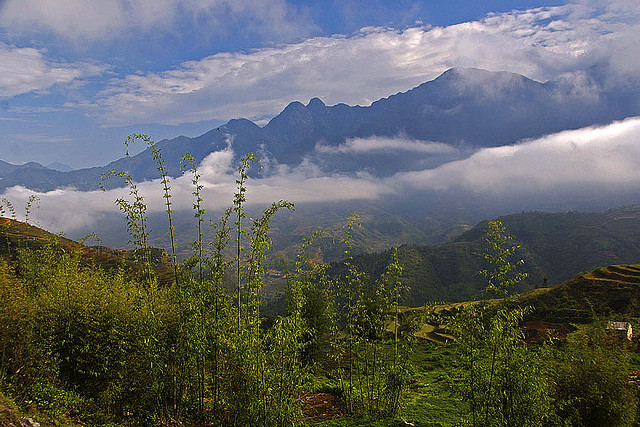 Picture by jmhullot
 Picture by Palojono
Sunset at Tram Ton Pass, after driving up from Sapa
 Picture by alex franka
Hmong village
A two to three hours drive from Sapa lies Bac Ha, a Hmong village. It has a Sunday market. You can get tours to this market, taking you at Lao Cai railway station when you arrive in the morning and afterwards bring you to your hotel in Sapa or the other way round, when you leave Sapa on Sunday, for example here.
 Picture by Tartarin2009
Bac Ha market
How you get to Sapa
By train:
From Hanoi to Lao Cai at the Chinese border (7 to 8 hours). You can travel with sleepers and book on vietnamrailways.com. Then get to the right railway station in Hanoi: The entrance is from Tran Quy Cap Street. See Hanoi Railway Station Google Map. From Lao Cai buses to Sapa (1 1/4 hour), take seat on the left side to have the best view.
Overland Travel to Luang Prabang: There’s no direct bus going to Luang Prabang from Sapa, notes flipnomand.com. His minivan left at around 8 am and took around eight hours to reach Dien Bien Phu (12 USD). There he took the bus to Mhuang Khua in Laos (5 USD) at 5.30 am via Tay Trang Border and arrived at around 2.30 pm. There he took a minibus the next morning to Udomxay and there another bus to Luang Prabang.
Where to stay in Sapa: Sapa Hotels and Guesthouses
Where to go from Sapa: Discoveries around Sapa
Restaurants: Where you eat in Sapa
 Picture by johnlemon
Rice fields down in Sapa Lao Cai
 Picture by ronancrowley
Tweet This
Subscribe to:
Posts (Atom)


