Enjoy the Vietnamese kitchen: Hanoi Delights and Discover old temples: Hue Impressions

Thursday, August 30, 2012

Hanoi Impressions

See all the locations on Hanoi Google Map by #treasuresofvietnam

Joss-sticks at Ngoc Son Pagoda, picture © ishmael 78


Listen to music about Old Hanoi:


Salt (muoi), roasted fish (cha ca), chicken (ga), beans (dau) or leather (da), baskets (bo) and bamboo (tre) or herbal medicine (thuoc bac): Whatever people used for daily life has it's own street name in the old town of Hanoi. The development of the old quarter started in the 11th century, when King Ly Thai built his palace. Craftsmen and their families settled in small villages around the palace walls. Later artisan guilds were formed. This was the birth of streets specialised in similar services. Today many guides write about "36 old streets", but actually there are around 70 streets in the old quarter. Some researchers believe that there were 36 guilds in the 15th century (read more in an article by Barbara Cohen).

What can we discover in the old quarter today? Frommer's has published a nice walking tour and we follow their route and start at the north end of Hoan Kiem Lake (Lake of the returned sword).


Den Ngoc Son (Jade mountain temple): On an island in Hoan Kiem Lake, built in the 18th century. From the shore we reach the pagooda through this gate:

Picture © marhas1

We cross the lake on The Huc (Morning sunlight bridge):

Wood is under the red painting, picture © marhas1

And we enjoy the look at this gate:

Picture © marhas1

Now smell the incence:

Picture © marhas1

Ngon Soc Pagoda, picture © iko


Hang Gai (Hemp street): Today you won't find hemp shops but boutiques, art galleries and silk tailors - and an old Banyan tree at 85 Hang Gai. There is a concentration of galleries near the intersection of Hang Gai and To Tich street (Thang Long Art Gallery and Dragon Art Gallery). Read more about shops along Hang Gai.

Tan My Design, picture © marhas1

Tan My Design is a small new shopping emporium selling local Vietnamese design as Chartage, Ha Truong, Minh Hanh, Ha Linh Thu, Huy Vo, Casa d'Oriental and Grace as well as brands from abroad.

Picture © marhas1

Picture © marhas1

Hang Gai, picture © Mimi

Silk, picture © dominiqueb

Banyan Tree, picture © Hanoi Mark


Tam Thuong Alley: Turn right from Hang Gai. Just some steps inside you discover Din Yen Thai Communal House. Read more about the Tam Thuong community. Here there used to be a palace of Y Lan, one of the most inspiring and captivating female figures in Vietnamese history (more here).

Flags during Tet in Tam Thuong, picture © Hanoi Mark

Ceremonial room in Yen Thai Temple, picture © hermmermferm


Yen Thai Street: You find yourself in a small openair market.

Yen Thai, picture © Sally Anderson.
See also picture by Optimism One and by Hanoi Jazz


Yen Thai Street, picture by 160cm


Hang Da Market (Leather Market): Here you used to find an old market from the 19th century with meat, vegetables, fruits and pottery on the ground floor, clothes and fabrics on the upper floors. See picture by Ariel Seche and Erin Armstrong. But now this building has been demolished and the construction of a new shopping complex is planned. Read "The Last day of Hang Da Market". See Mariel Bautista's photos of the old market. And read the blog of Vietnamese God about the transformation of shopping in Hanoi from old to new.


Old Hang Da Market, picture by rathmax


Hang Dieu Street (Street of pipes): It used to be the street of the tobacco- and pipesellers.


Bat Dan Street (Wooden Bowles): It was once the street of the sellers of clay bowls. See the communal house at 33 Bat Dan, temple at the corner of Bat Dan and Hang Ga


Bat Dan, picture by 160cm


Thuoc Bac Street (Herbal Medicine Street): This used to be the place for traditionel medicine. Thuoc Bac is the traditional Northern Medicine, also called Chinese traditional medicine. Read a background story by Lena Lopez. Today metallic stuff dominates the street. See street-picture by Williewonker


Thuoc Bac Street, picture by permanently scatterbrained


Hang Phen Street (Alum Street): See picture by Willie Wonker. At 25 Hang Phen you find Mr Lee's Style Shop, one of some clothing boutiques in this area. Also Bat Su has.


Bat Su Street (China Bowls Street): About the Café on 61 Bat Su writes Motormouth from Ipoh. "Look for a preserved traditional house, characterized by its low tile roofline, at no. 52 Bat Su", advises frommers.com

Read more: http://www.frommers.com/destinations/hanoi/0197010008.html#ixzz0SyEB5mJc


Pho Bat Su, picture by loveme


Architecture in Bat Su, picture by Hon Weng


Cua Dong Street: It leads you to Hanoi Citadel, the former residence of Vietnam monarchs. The Ly Dinasty constructed it in 1010 (read about the history on the World Heritage site of Unesco and Jennifer Pinkowski's article in the New York Times). The Roayal Palaces and other buildings have been destroyed by the Frech in the 19th century. Some buildings remained: Doan Mon gate, the Watchtower, the steps of Kinh Thien Palace and Hau Lau (Princess Palace). The Vietnamese military command under General Giap had its headquarters in the citadel (building D67). See pictures by ngocpq

Doan Mon:


The left gate, picture by dohuyen


From the basement up, picture by dohuyen


Doan Mon Gate, picture by ThanhTam

The Watchtower:


The Watchtower, picture by cluzzie

Dinh Kien Tien: See a video-animation on youtube.com


Phung Hung:


Picture © DucLoi


Picture © Hanoi Mark


Hang Vai (Cloth Street): You find stands of cut bamboo poles for construction. See picture by kk_wpg and eujintay


Picture © hermmerferm


Picture © vui


Picture © Alex Gooi


Lang Ong: See picture of crossroads Hang Ngang, Hang Duong, Lan Ong and Hang Buom and see picture of Lan Ong.


Picture © dainee


Pho Cha Ca (Roasted Fish Street):


Picture © Duc Loi


Hang Ca
: See picture by dopdk love you


Picture © DucLoi


Hang Duong (Sugar street):


Traffic at Hang Ma and Hang Duong Crossroads. Picture © aquanica68


Picture © Hanoi Mark


Hang Chieu (Mats street):

Stall selling fried prawn with flour, dipped in Viet sauce and eaten with vegetables in a small lane between Hang Chieu and Cau Dong street. Picture © * etoile


Picture © DucLoi


Quan Chuong Gate:


Picture © Dan


Nguyen Sieu:


Picture © DucLoi. See also picture by Yvonnechan


Hang Giay (Shoes street ?):


Picture © marhas


Picture © Alfred Wilhelm

Picture © Alfred Wilhelm


Picture © Alfred Wilhelm


Hang Buom (Sail street): The people living here made and sold sails, because there were water channels between the Red River and the To River. Later Hang Buom became the commercial and residential center of Chinese merchants. Look at the colonial buildings and traditional Vietnamese houses.

Picture © Maocho

View from Ladybird Restaurant at 57 Hang Buom, picture © handinhand


Den Bach Ma, picture © aquanica68

Den Bach Ma (The White Horse Temple) dates from 1010. What you see today is a reconstruction from the 18th and 19th centuries. Read the story of the White Horse on orientalarchitecture.com. Open from 7:30 to 11:30 am and 1:30 to 6 pm daily.

Inside Den Bach Ma, picture © marhas1

© marhas1


Ma May: At 87 Ma May you find a restored traditional house from the late 19th century. Here, for a fee of just 20,000 VND, a young guide dressed in a traditional ao dai will show you the building and tell you about the life in the past. The renovation has been funded by a UNESCO-, French- and Canadian-backed organization. 87 Ma May is a typical "tube house": These houses "can be as long as 70 meters and as narrow as two meters - this developed as an attempt to minimize taxes, as each property was taxed according to the width of the street-facing facade. To allow for sufficient light in these narrow dwellings, it was necessary to design multiple courtyards along the length of each house.", notes orientalarchitecture.com

87 Ma May, picture © Kathryn

View of the middle room from the veranda, picture © marhas 1

View across the outermost courtyard, picture © Maggie


The rear patio, picture © marhas 1

On the bed, picture © marhas1

Ma May, picture © StrudelMonkey

22 Ma May, picture © Loris Candylaftis


The Food Laboratory describes a walking tour through the old town of Hanoi, read.

One Pillar Pagoda:


Picture by Mimi


Dong Xuan Market


Cho Dong Xuan, picture by ThanhTam


Recommend this blog on Twitter and Facebook:

Tweet This

Saturday, August 11, 2012

Sapa - a magic mountain scenery above the mist

See the locations on Sapa Google Map and see the Weather in Sapa

Picture by marhas
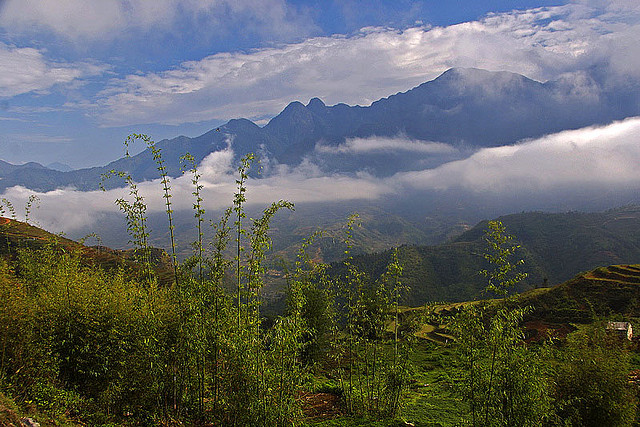
Sapa morning: The mist is leaving and the view towards the valley with the rice terraces is opening

Picture by Lawrence Sinclair

Picture by ronancrowley

Picture by n gr0uch0
Sapa Square with churchbr>
It's a long one-hour drive from the town Lao Cai on a road winding up into the Hoan Lien Son mountain range near the Chinese border in northwestern Vietnam. Up to 1650 m above sea level. Into a town, that may be still enclosed by mist, when you arrive early in the morning. There you may witness, how the mist is floating away and discloses a fine rugged scenery and rich cultural diversity, great views into the surrounding mountains and valleys, towards the famous rice terraces with the farm houses of the hill tribe people (Hmong and Dao) living around this town in the Tonkinese alps. The picturesque village is a former French hill station near Fansipan, the highest peak in Vietnam, rising from the Red River Valley. And you find here a very special atmosphere: something between a Vietnamese hilltribe-market-town and a skistation in the French mountains. Sapa’s streets are the business place to the Hmong, Dao, Giay, Pho Lu and Tay people. Their traditional ethnic dresses make the difference from the many nations, who come to Sapa to plunge in its landscape. The women of these groups carry their handmade goods on their backs in traditional wicker baskets to barter and trade with tourists.

Picture by marhas
Cau May street: Full of restaurants, handicraft- and outdoorshops and leading to the market


Muong Hoa Street: Wine and chocolate and more food

Picture by marhas
Cau May Street: The Hilltribe Mini Hotel, the Highland Bakery Restaurant and the Sapa Trekking Shop

Pictures by marhas
Pastries in the window of Highland Bakery

Picture by marhas
Crafts and fashion

Picture by marhas
Skipants in Sapa? Sometimes Sapa sees some snow - and normally a lot of tourists buying outdoorclothes

Picture by marhas
Flowers at the market

Picture by Hector Garcia
Black Hmong women at Sapa market

Picture by marhas
Black Hmong women waiting

Picture by marhas
Sapa street food

Picture by Arian Zwegers

Picture by marhas
In the evening: The mist creeps around the corner


Red Dzao Traditional Medicine Bath: 10 Thac Bac Street. Read about this experience. Due to the isolation in the mountains herb medicine plays an important role in protecting the health of the Dao people. There are plenty of herbs in the forests. During the herbal bath they drink restoratives. This helps women recuperate after giving birth, stimulate their appetite and protect infants from disease via their mothers milk. According to the wisdom of the Dao people a herbal bath helps against physical and mental fatigue and it enhances blood circulation. For women the herbal bath promises skin beauty by opening pores, removing dead skin and impurities. Read more: Trying medicinal bathing with the Dao

Picture by marhas
Red Dzao Traditional Medicine Bath


There is something in Sapa, that can be enervating. "Welcome to Sapa, home of the hard sell", writes the Ottawa Citizen. Susan Riley describes: "From the moment you step out of your minivan in the town of Sapa (...) you will be besieged by Hmong women - short, friendly, decked out in bright head scarves, patterned umbrellas and dark leggings and as persistent as black flies. They followed us everywhere (...) - even on a three-hour "trek" through high pastures, sodden rice paddies and down slippery goat paths to a neighbouring village. We told them we weren't buying the blankets, trinkets and scarves they carry in woven baskets; we asked them politely to let us walk in peace; finally, we affected tight smiles and tried ignoring them." As tourist you are really in the dilemma: You would like to be polite and answer their questions (where are you from?), but if you do this, you encourage them to follow you because they think sooner or later you are going to buy from them. "Don't talk to them", is the advise of the local Tay guide, who shows the author of this blog around. Another advise: "Say you are Belgian - they know that Belgians newer buy". Or should you buy, because you are a rich tourist and should give something of your richness away, because you know, that many people in the mountains of Vietnam are still poor and have not a lot of possibilities in their lifes? You are in a dilemma.

The tourism boom in Sapa has its backside. Some parents take the children out of school and send them to sell things to tourists. But there is an organization fighting against this and better education and formation for children: Sapa O'Chau. This organization, founded by Shu, a Black Hmong woman (see video1 and video2), is attracting children to their school classes of English language and guidework and then send the well prepared young guides to tours with guests or other work in the tourism. Today Sapa O'Chau has over 70 students. And you can get here experienced guides for trekking tours or tours to local markets.


Sapa O'Chau Café - where you book tours with their guides

While Sapa itself has much adapted to tourism - with more and more guesthouses and hotels lining its streets, all competing for the best views, with restaurants for many tastes of the world - the landscape around the town remains stubbornly untouched: Rice terraces, who have been built by generations, water buffaloes, pigs and ducks in between and the hilltribe people working in the rice paddies and on their handicrafts.

Special nights in Sapa used to be Saturday evenings. Then men and women from the surrounding hilltribes come to the "Love market" or better: dating market (Cho Tinh, see pictures). Which is described by edbourke.net. But the growing interests of tourists has destroyed this event. Young people now find other ways to date. What happens now is described by vietnamnet.vn.


Sapa Museum:

Picture by marhas
Hmong Shaman Altar


The main season for vistors is from September to November or from March to May with dry sunny days and cool nights.


Picture by jmhullot

Picture by Palojono
Sunset at Tram Ton Pass, after driving up from Sapa

Picture by alex franka
Hmong village


A two to three hours drive from Sapa lies Bac Ha, a Hmong village. It has a Sunday market. You can get tours to this market, taking you at Lao Cai railway station when you arrive in the morning and afterwards bring you to your hotel in Sapa or the other way round, when you leave Sapa on Sunday, for example here.

Picture by Tartarin2009
Bac Ha market


How you get to Sapa

By train:
From Hanoi to Lao Cai at the Chinese border (7 to 8 hours). You can travel with sleepers and book on vietnamrailways.com. Then get to the right railway station in Hanoi: The entrance is from Tran Quy Cap Street. See Hanoi Railway Station Google Map. From Lao Cai buses to Sapa (1 1/4 hour), take seat on the left side to have the best view.

Overland Travel to Luang Prabang: There’s no direct bus going to Luang Prabang from Sapa, notes flipnomand.com. His minivan left at around 8 am and took around eight hours to reach Dien Bien Phu (12 USD). There he took the bus to Mhuang Khua in Laos (5 USD) at 5.30 am via Tay Trang Border and arrived at around 2.30 pm. There he took a minibus the next morning to Udomxay and there another bus to Luang Prabang.


Where to stay in Sapa: Sapa Hotels and Guesthouses

Where to go from Sapa: Discoveries around Sapa

Restaurants: Where you eat in Sapa


Picture by johnlemon
Rice fields down in Sapa Lao Cai

Picture by ronancrowley

Tweet This

Sapa Hotels and Guesthouses

See the locations on Sa Pa Hotels and Guesthouses Google Map

Bamboo Sapa Hotel: The views are "out of this world", the breakfast is excellent, according to reviews on tripadvisor.com. But there is no elevator. And the room walls are not soundproof. See the hotel on youtube.

Fansipan View Hotel: From USD 28. Xuan Vien Street. Train station pickup included. A boutique hotel with 15 basic rooms, overlooking the valleys of Sapa and Fanispan mountain. All deluxe rooms with balcony. No Aircondition, but this is not necessary. Good reviews on tripadvisor.com

Picture by Fansipan View Hotel


Victoria Sapa Resort & Spa Hotel: 77 rooms with private terrace. The hotel is situated on a hill. The pool, spa and some other facilities are more up the hill. A private train of Victoria Hotels is running from Hanoi to Lao Cai. "A top notch hotel" according to the reviews on tripadvisor.com

Picture by thomaswanhoff


Sapa Garden Bed & Breakfast: From 43 USD. 102 Dien Bien Phu Road, about 2.5 km away from the center of Sapa town (walkable within 20-30mins). A renovated French style Villa with three bedrooms and garden. "Best kept secret in Sapa" according to excellent reviews on tripadvisor.com.

Picture by Sapa Garden Bed & Breakfast
Bed and Breakfast in a French style villa


Sapa Rooms Boutique Hotel: From 59 USD. There can be noise from the street, say good reviews on tripadvisor.com. See picture on flickr.com.

Picture by David McKelvey


Thai Binh Sapa Hotel: "A great choice" according to very good reviews on tripadvisor.com. See picture by feng77


The Village Noshery:

Read more and see pictures: Sapa Impressions

Where to go from Sapa: Discoveries around Sapa

Restaurants: Where you eat in Sapa


Tweet This